Quick answer
Wegovy (semaglutide) and Saxenda (liraglutide) are both GLP-1 receptor agonists made by Novo Nordisk for chronic weight management. The two big differences are dose schedule and effectiveness. Wegovy is a single weekly injection and produced about 14.9% average weight loss in the STEP 1 trial. Saxenda is a daily injection and produced about 8% average weight loss in the SCALE Obesity trial. A head-to-head study (STEP 8) found semaglutide was roughly twice as effective as liraglutide. Side effects and the boxed warning are nearly identical. List prices are similar, around $1,349 per month, but Wegovy now offers a $499 self-pay option through NovoCare Pharmacy that Saxenda does not match.
For most patients beginning treatment in 2026, Wegovy is the more effective and more convenient choice. Saxenda still has a role — particularly in step therapy protocols, in patients who tolerated it well in the past, and in situations where rapid medication washout is desirable. The rest of this guide explains those distinctions in detail.
Section 02
Comparison table
The numbers below come from the FDA prescribing information for each drug and from the manufacturer's pivotal trials. List prices are average U.S. retail figures as of April 2026 and are subject to change.
| Wegovy | Saxenda | |
|---|---|---|
| Brand name | Wegovy | Saxenda |
| Active ingredient | semaglutide | liraglutide |
| Drug class | GLP-1 receptor agonist | GLP-1 receptor agonist |
| FDA indication | Chronic weight management | Chronic weight management |
| How it’s taken | Subcutaneous injection, once weekly | Subcutaneous injection, once DAILY |
| Maximum dose | 2.4 mg weekly | 3.0 mg daily |
| Average weight loss | 14.9% body weight at 68 weeks (STEP 1 trial) | ~8% body weight at 56 weeks |
| FDA approval | 2021 | 2014 |
| List price | $1349/mo retail, $499/mo NovoCare cash pay | ~$1349/mo retail |
A few things stand out at a glance. Same drug class, same manufacturer, same general indication — but very different dose schedules, very different weight loss outcomes, and a seven-year gap in FDA approval. Saxenda was the first drug in this class approved for weight loss; Wegovy was built on what Novo Nordisk learned from it.
Section 03Same class, different molecules: semaglutide vs liraglutide
Both semaglutide and liraglutide are GLP-1 receptor agonists — synthetic peptides engineered to mimic the natural gut hormone glucagon-like peptide-1. Natural GLP-1 is released by the small intestine after a meal. It signals fullness to the brain, slows stomach emptying, and stimulates insulin release. The body breaks it down within minutes, which is why a synthetic version is needed for therapeutic use.
Liraglutide was the first long-acting GLP-1 designed for once-daily use. Novo Nordisk modified the natural human GLP-1 sequence by adding a fatty acid side chain that lets it bind reversibly to albumin in the blood. That modification stretched the half-life from about two minutes to roughly 13 hours — long enough for once-a-day dosing.
Semaglutide is the next generation. It uses a similar fatty acid trick but with additional amino acid substitutions that further protect the molecule from enzymatic breakdown. The result is a half-life of about 165 hours, or roughly seven days. That single biochemical improvement is why one drug is taken weekly and the other daily — and it has knock-on effects on patient adherence, plasma drug levels, and overall weight loss.
A weekly drug produces a smoother, more constant blood level of medication. Daily drugs have more peak-and-trough fluctuation, which can amplify side effects after each dose and contribute to less consistent appetite suppression between doses. The smoother semaglutide curve is part of the reason it tends to outperform liraglutide in head-to-head studies.
Receptor binding and selectivity
Both drugs activate the GLP-1 receptor with high specificity. Neither one targets the GIP receptor, which is what sets them apart from tirzepatide (the active ingredient in Zepbound and Mounjaro). At the receptor level, semaglutide and liraglutide work very similarly. The differences in clinical outcomes come from drug exposure and the higher steady-state concentrations Wegovy can sustain.
Section 04Weekly vs daily injection — the practical difference
On paper, the difference between one injection per week and one per day looks small. In real life it shapes how patients experience the drug, how easy it is to stay on it for years, and whether weight loss actually translates into long-term success.
| Factor | Wegovy (weekly) | Saxenda (daily) |
|---|---|---|
| Injections per year | 52 | 365 |
| Pen format | Pre-filled, single-use weekly pen | Multi-dose pen, dial-up dose, replace needle |
| Adherence in real-world studies | ~65% at one year | ~30% at one year |
| Missed-dose impact | Take within 48 hours, otherwise skip | Skip and resume next day |
| Travel friendly | Pack one pen per week | Pack pen plus needles for every day away |
| Storage | Refrigerate, 28 days at room temp once started | Refrigerate, 30 days at room temp once started |
The adherence gap is the real headline. A 2023 retrospective study of commercial pharmacy claims found that approximately 65% of patients on a weekly GLP-1 were still filling prescriptions at 12 months, compared to only about 30% of patients on a daily GLP-1. Weight loss medications only work while you take them, so adherence is not a trivial concern — it directly translates into outcomes.
Daily injection is also a quiet psychological burden. Many patients describe Saxenda as "another thing on the list" along with brushing teeth and taking morning supplements. Wegovy's once-a-week routine is easier to anchor to a recurring event — Sunday morning coffee, for example — and fades into the background of normal life.
Section 05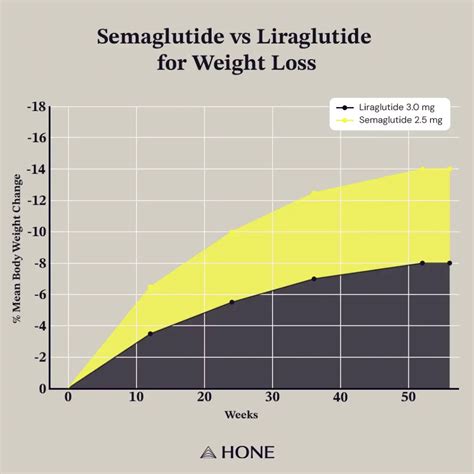
Effectiveness: Wegovy wins on weight loss
Both drugs were tested in large randomized trials against placebo. They were also tested against each other directly. The data tells a clear story.
| Trial | Drug & dose | Duration | Average weight loss |
|---|---|---|---|
| STEP 1 (Wegovy) | Semaglutide 2.4 mg weekly | 68 weeks | 14.9% |
| SCALE Obesity (Saxenda) | Liraglutide 3.0 mg daily | 56 weeks | 8.0% |
| STEP 8 (head-to-head) | Semaglutide 2.4 mg vs liraglutide 3.0 mg | 68 weeks | 15.8% vs 6.4% |
| Placebo (pooled) | Lifestyle alone | 56-68 weeks | ~2.4% |
The STEP 8 trial is the most important result here because it compared the two drugs head-to-head in the same population over the same duration. Adults on semaglutide lost 15.8% of body weight at 68 weeks; adults on liraglutide lost 6.4%. That is more than double. STEP 8 also looked at the proportion of patients hitting weight-loss milestones: 70% of the semaglutide group lost at least 10% of body weight, compared to 26% of the liraglutide group.
Why such a big gap when the drugs work on the same receptor? Two reasons. First, semaglutide can be dosed to higher cumulative weekly exposure — 2.4 mg once a week versus 3.0 mg per day, or 21 mg per week. Second, the smoother weekly pharmacokinetics produce more sustained appetite suppression than the daily peak-and-trough pattern of liraglutide. Both factors combine to drive the difference.
For patients still considering options, our Wegovy vs Zepbound comparison covers the third drug in this conversation — tirzepatide produces about 20.9% weight loss in trials, more than either GLP-1 alone.
Section 06Side effect profile
Because Wegovy and Saxenda activate the same GLP-1 receptor, their side effect profiles are almost identical. The most common adverse events are gastrointestinal: nausea, diarrhea, vomiting, constipation, and abdominal pain. The frequency, severity, and onset are broadly similar between the two drugs in clinical trials.
| Side effect | Wegovy (STEP 1) | Saxenda (SCALE) |
|---|---|---|
| Nausea | 44% | 40% |
| Diarrhea | 32% | 21% |
| Vomiting | 25% | 16% |
| Constipation | 24% | 20% |
| Abdominal pain | 20% | 14% |
| Discontinued due to side effects | ~7% | ~10% |
Wegovy's higher rates partly reflect the higher cumulative drug exposure — patients are on a stronger dose for longer. Despite that, fewer people quit Wegovy due to side effects than quit Saxenda, suggesting the smoother weekly pharmacokinetics may be slightly easier to live with day to day.
Both drugs share the same serious-but-rare warnings: pancreatitis, gallbladder disease, kidney injury from dehydration, and a boxed warning about thyroid C-cell tumors observed in rodent studies. Both are contraindicated in patients with a personal or family history of medullary thyroid carcinoma or multiple endocrine neoplasia syndrome type 2 (MEN 2). Our Wegovy side effects guide covers these in more depth and applies to Saxenda almost word for word.
Severe abdominal pain that radiates to the back, persistent vomiting and dehydration, jaundice or yellowing of the eyes, a new neck lump or persistent hoarseness, or signs of severe allergic reaction. These warnings apply equally to Wegovy and Saxenda.
Cost and insurance
Sticker prices for Wegovy and Saxenda are nearly identical. Both list at roughly $1,349 per month at most U.S. retail pharmacies. The differences show up in the discount programs and how each manufacturer routes uninsured patients.
| Pricing scenario | Wegovy | Saxenda |
|---|---|---|
| Retail list price | ~$1,349/mo | ~$1,349/mo |
| Manufacturer self-pay direct | $499/mo via NovoCare Pharmacy | Not currently offered |
| Commercial insurance + savings card | $0-$25/mo for eligible patients | $25/mo for eligible patients (24-month limit) |
| Medicare Part D | Generally not covered for weight loss; cardiovascular indication may qualify | Not covered for weight loss |
| Medicaid | Varies by state; most exclude weight loss drugs | Varies by state |
For uninsured patients in 2026, Wegovy is meaningfully cheaper than Saxenda because of the NovoCare $499 self-pay option. Saxenda has not introduced an equivalent program, so an uninsured patient on Saxenda is generally paying full retail or hunting for GoodRx coupons that bring it to roughly $1,200 per month.
For insured patients, the picture flips. Many commercial formularies still cover Saxenda more reliably than Wegovy, and the Saxenda Savings Card brings the copay down to $25 for eligible patients. We break down all of this in the Wegovy cost guide.
Section 08Step therapy: when your insurance makes you try Saxenda first
Step therapy — also called "fail first" — is a cost-control policy used by pharmacy benefit managers and health insurers. It requires patients to try a less expensive or older drug before the insurer will pay for a newer or pricier alternative. For GLP-1 weight loss drugs, that often means trying Saxenda before getting Wegovy approved.
The logic from the insurer's side is straightforward. Both drugs are expensive. Saxenda has been on formularies longer, has been negotiated to lower net prices in some plans, and demonstrably produces clinical weight loss for many patients. Insurers reason that if a patient does well on Saxenda, the plan saves money. If the patient fails or cannot tolerate Saxenda, the request for Wegovy can then be approved on appeal.
How a typical step therapy protocol looks
- Your provider prescribes Wegovy at your first visit.
- The pharmacy submits the claim. Insurance rejects it citing step therapy.
- Your provider receives a denial letter explaining the requirement: typically a 12 to 16 week trial of Saxenda at the maximum tolerated dose.
- You start Saxenda. If you lose weight and tolerate it, the plan generally expects you to stay on Saxenda.
- If you do not lose at least 5% of your starting weight by week 12 to 16, or if you cannot tolerate the drug due to side effects, your provider can submit a step therapy override or prior authorization for Wegovy.
- Wegovy is then approved (often with a separate prior authorization for medical necessity).
Patience helps. So does documentation. Keep a written log of side effects, dose changes, and your weight measurements. If you need to escalate a denial, that paper trail is what your provider will use to argue medical necessity.
Step therapy only applies to insurance claims. If you use the NovoCare $499 self-pay program for Wegovy, no insurance is billed and no step therapy applies. For some patients who would otherwise spend months on Saxenda, this is the faster route.
Who Saxenda might still be right for
Wegovy is more effective for most patients, but Saxenda is not obsolete. There are several scenarios where it remains a reasonable or even preferred choice.
- Step therapy patients. If your insurance plan requires a Saxenda trial before approving Wegovy, the easiest path is to take Saxenda properly for the required period and then transition. Fighting the protocol can delay treatment by months.
- Patients who tolerated it well in the past. Some people came off Saxenda for non-medical reasons — cost, life events, discontinuation by a previous provider — and want to restart something familiar. Restarting a drug you already know how to use is often easier than learning a new one.
- Patients who want fast washout. Liraglutide leaves the body within a few days. Semaglutide takes weeks to clear. If you have a planned surgery, a pregnancy plan, or a known sensitivity to GLP-1 effects, the shorter half-life of Saxenda gives more control.
- Pediatric patients aged 12-17. Saxenda was FDA-approved for adolescents with obesity in 2020, and Wegovy received pediatric approval in 2022. Both are now options, but some pediatric obesity specialists still default to Saxenda because they have more years of clinical experience with it in younger patients.
- People who genuinely prefer daily routines. A small group of patients prefers daily dosing because it feels more like "taking control" or fits better with their habit-tracking system. For these patients, the daily injection is a feature, not a bug.
Saxenda was a breakthrough in 2014. It was the first injectable GLP-1 specifically indicated for chronic weight management and it built the clinical foundation for everything that came after. It is reasonable to use it; it is just no longer the most effective option for most new patients.
Section 10Can you switch from Saxenda to Wegovy
Yes, and the transition is one of the simpler medication changes in this category because both drugs are made by the same manufacturer and act on the same receptor. There is no required washout period between them.
Typical switching protocol
- Take your last dose of Saxenda on a chosen "switch day."
- Wait one full day to clear most of the liraglutide from your system.
- Start Wegovy at the standard 0.25 mg weekly starting dose, even if you were on the maximum 3.0 mg of Saxenda.
- Follow the standard 16 to 20 week titration up to 2.4 mg weekly.
The reason providers do not skip the Wegovy titration is tolerability. Even though your body is used to liraglutide, semaglutide has different pharmacokinetics and a higher cumulative weekly dose. Starting at 0.25 mg minimizes the risk of nausea and vomiting in the first few weeks. Most patients who switch report either similar or fewer GI side effects than they had on Saxenda, partly because they are no longer experiencing daily peak doses.
Insurance approvals for the switch usually require documentation of either inadequate weight loss on Saxenda (less than 5% at 12-16 weeks) or intolerable side effects. Some plans approve the switch automatically after a documented Saxenda trial; others require a fresh prior authorization. Our cost and insurance guide has more on the prior authorization process.
Section 11Briefly: how does Contrave fit in?
Contrave (bupropion plus naltrexone) is a third option that comes up in the same conversation. It is worth a short mention because some patients are weighing all three drugs simultaneously.
Contrave is an oral pill, not an injection, and it is not a GLP-1. It combines an antidepressant (bupropion) with an opioid antagonist (naltrexone) to reduce appetite and food cravings through brain reward pathways. In its pivotal trials, average weight loss was approximately 5% of body weight at one year — meaningfully less than Saxenda's 8% and far less than Wegovy's 14.9%.
Contrave has its own side effect profile: nausea, headache, constipation, dizziness, insomnia, and dry mouth. It is contraindicated in patients with seizure disorders, eating disorders, uncontrolled hypertension, or chronic opioid use. List price runs roughly $700 per month, with manufacturer savings cards bringing it as low as $99 per month for eligible patients.
For patients who refuse injections or who have a specific contraindication to GLP-1 drugs, Contrave is a real option. For most others, even Saxenda outperforms it. Wegovy remains the more effective choice for nearly anyone who can tolerate injections.
Section 12The bottom line
Wegovy and Saxenda are siblings. Same drug class, same manufacturer, same general indication. The differences are real and meaningful: Wegovy delivers roughly twice the weight loss of Saxenda, in one weekly injection instead of seven, with comparable side effects and a cheaper self-pay path. That is why most new patients in 2026 start on Wegovy.
Saxenda still matters. It opened the door for an entire category of weight loss medication and remains a practical choice for step therapy compliance, restart patients, and short-half-life situations. It is not an inferior drug — it is an older drug that has been outperformed by its own next generation.
If you are weighing your options, the most useful next steps are to check your insurance formulary, look up the current pricing in detail, and consider a brief telehealth visit to discuss the right starting drug with a licensed provider.
You may also want to read our other comparison guides: Wegovy vs Ozempic, Wegovy vs Zepbound, or the full comparison table of all GLP-1 weight loss drugs.
Frequently Asked Questions
Is Wegovy better than Saxenda for weight loss?
On average, yes. In the STEP 1 trial, adults on Wegovy 2.4 mg lost about 14.9% of body weight at 68 weeks. In the SCALE Obesity and Prediabetes trial, adults on Saxenda 3.0 mg lost about 8% at 56 weeks. A head-to-head trial called STEP 8 compared the two drugs directly and found semaglutide produced roughly twice the weight loss of liraglutide at the same time point.
Why do I have to inject Saxenda every day but Wegovy only once a week?
Liraglutide, the active ingredient in Saxenda, has a half-life of about 13 hours. Semaglutide, the active ingredient in Wegovy, has a half-life of about a week — roughly 165 hours. Novo Nordisk engineered semaglutide with a fatty acid chain that lets it bind to albumin in the blood, dramatically slowing its breakdown. That structural difference is the entire reason one drug is daily and the other is weekly.
Can I switch from Saxenda to Wegovy?
Yes, and many patients do. The transition is generally straightforward because both drugs are GLP-1 receptor agonists made by the same manufacturer. Most providers stop Saxenda and start Wegovy at its standard 0.25 mg starting dose, then titrate up over 16 to 20 weeks. Your prior tolerance of liraglutide is a useful clue but does not let you skip the Wegovy titration schedule.
Does insurance cover Saxenda or Wegovy more easily?
Saxenda has been on the market since 2014 and is sometimes on formularies that have not yet added Wegovy. Many commercial plans use step therapy that requires patients to try Saxenda first and fail or stop tolerating it before approving Wegovy. Coverage varies enormously by plan, employer, and pharmacy benefit manager, so checking your specific formulary is the only way to know.
Are the side effects of Wegovy and Saxenda the same?
They are very similar because both drugs activate the same GLP-1 receptor. Nausea, diarrhea, vomiting, constipation, and abdominal pain are the most common side effects of both. Some patients tolerate one drug better than the other, but there is no consistent evidence that either has a meaningfully gentler GI profile. Both carry the same boxed warning about thyroid C-cell tumors observed in rodent studies.
How much does Saxenda cost compared to Wegovy?
The retail list price of Saxenda is roughly $1,349 per month, almost identical to Wegovy. With commercial insurance and the Saxenda Savings Card, eligible patients may pay as little as $25 per month for up to 24 months. Wegovy patients can use the NovoCare self-pay option at $499 per month, which Saxenda does not currently match. For uninsured patients, Wegovy is usually cheaper out of pocket.
Is Saxenda being discontinued?
No, Saxenda has not been discontinued. Novo Nordisk still manufactures and distributes it in the United States. However, prescribing has shifted heavily toward Wegovy and Zepbound since 2021, and some pharmacies stock less of it than they used to. If your pharmacy is short on Saxenda, ask whether another local pharmacy carries it or whether your doctor can route the prescription to NovoCare.
Is Saxenda the same as Victoza?
Both contain liraglutide and are made by Novo Nordisk, but they are not the same medication and are not interchangeable. Victoza is approved for type 2 diabetes at doses up to 1.8 mg daily. Saxenda is approved for chronic weight management at doses up to 3.0 mg daily. The maximum weight-loss dose is higher than the maximum diabetes dose, which is why they are sold as separate products.
How does Contrave compare to Wegovy?
Contrave is an oral pill that combines bupropion and naltrexone. It is not a GLP-1 and works on brain reward and appetite pathways instead. Average weight loss with Contrave is roughly 5% of body weight at one year, compared to 14.9% for Wegovy. Contrave is cheaper and pill-based, but markedly less effective. It is sometimes preferred by patients who cannot or will not inject.
Which is better for someone over 65?
Both drugs are studied and used in older adults, but neither is FDA-approved specifically for the geriatric population. Older adults on multiple medications and at risk for dehydration, kidney issues, or sarcopenia should be monitored carefully. Some clinicians prefer to start with Saxenda because daily dosing makes it easy to stop quickly if a problem arises, while others prefer Wegovy for its smoother weekly profile and stronger evidence base.